
defibrillations
shock-a-jigga

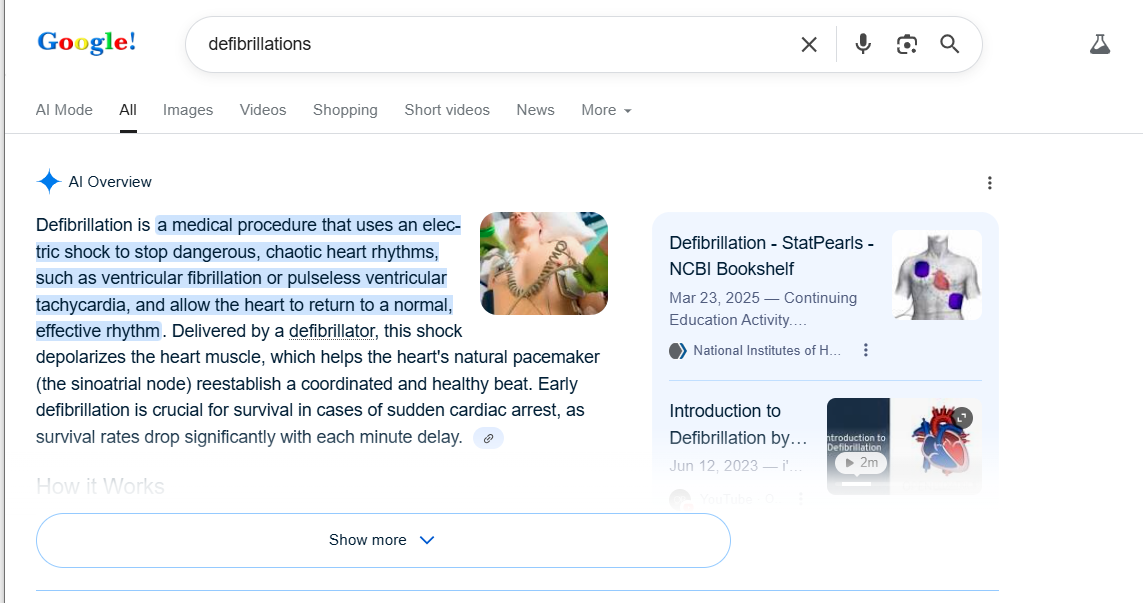
the defibrillator is an honest machine. it’s an acknowledgement of what we refuse to see: that the more lifeless we become, the greater the shock required to return us to rest. not the false rest of the wall-e lounger, but the true rest of equilibrium, where the heart beats not because it must but because it knows how.
consider the progression: a gentle tap on the shoulder. a shake. a slap. the paddles charged to 200 joules. 360 joules. clear. the intensity scales with our distance from life. this is not metaphor—this is electrical engineering rendered visible in flesh.
electricity is distance from rest, and nowhere is this more literal than in ventricular fibrillation, where the heart has become pure electrical chaos, quivering like a freakshake of cardiac muscle, all potential and no rhythm. the heart has forgotten how to be a heart. it has become instead a disco ball of electrical signals, each cell firing independently, the ultimate expression of individualism taken to its cellular conclusion. i’m electrocuted.
to understand defibrillation, let us import an electrical engineering ontology into our bodies. we are not organisms—we are circuits. the sinoatrial node is not a pacemaker but an oscillator. the atrioventricular node is not a gateway but a resistor. the purkinje fibers are not nerves but conductors. and when the system fails, when the circuit breaks, we do what any electrical engineer would do: we turn it off and turn it back on again.
but here’s what the medical textbooks won’t tell you: the shock doesn’t restart the heart. it stops it. completely. for a moment that stretches like taffy, the heart enters true electrical silence—zero volts, ground state, the deepest rest it may ever know. and from that void, if we’re lucky, emerges the tentative lub-dub of a system remembering itself.
this principle extends beyond cardiac muscle. the more dead we feel inside, the more electricity we need across every domain. our music evolves from acoustic guitar to electric guitar to electronic dance music pumping at 140 bpm. our food escalates from milk to milkshake to freakshake—each iteration more electric, more distant from rest. our media progresses from books to television to doom-scrolling tiktok at 3am, each format delivering more voltage per second. we’re titrating our stimulation dose upward, chasing the same feeling a gentle breeze once provided.
the aed hanging on the wall of your local starbucks is a monument to our collective electrical exhaustion. we have built a society so far from rest that we need defibrillators in our coffee shops. between the espresso machine and the emergency cardiac equipment, we’ve created perfect symmetry: one device to speed the heart, another to shock it back to rhythm when it finally breaks. and in between, we consume increasingly electric experiences—louder, faster, more saturated, more shocking—because nothing gentle can reach us anymore. hey guys, life is real.
christopher alexander would recognize this instantly. a heart in fibrillation has lost all fifteen properties of life. no boundaries between its electrical territories. no local symmetries in its contractions. no alternating repetitions, just chaos. the defibrillator is architectural intervention at the cellular level—a violent reorganization of space-time in cardiac muscle.
the more lifeless we become, the higher the voltage required. this is ohm’s law applied to the soul. resistance increases with distance from life. a person who meditates daily might need only a whisper to return to themselves. someone lost in the freakshake reality of infinite scroll might need lightning.
think about the escalation: a child delighted by a cardboard box. a teenager needing a smartphone. an adult requiring virtual reality. each generation needs exponentially more electrical stimulation to feel anything at all. our theaters evolved from shakespeare’s wooden O to imax to 4dx with moving seats and water spray—desperately trying to shock audiences into feeling present. our restaurants progressed from home cooking to molecular gastronomy to dining experiences with synchronized projections and soundscapes. everything must be an event, an activation, an experience—because simple presence no longer registers on our deadened sensors.
‘the electric universe is the interface through which consciousness interacts with and shapes the universe,’ and the defibrillator is our most desperate interface, our emergency api to consciousness. when all other protocols fail, when the handshake between mind and body drops, we send a packet of pure electricity—no headers, no metadata, just raw voltage—hoping the system will reboot.
tomato plants communicate through electrical signals in the soil. bees navigate by static charge. the mycorrhizal networks pulse with information. and here we are, the supposedly advanced species, requiring industrial quantities of electricity just to maintain(?) basic cardiac rhythm. we’ve become so electric that we need medical-grade grounding.
watch the trace on the ekg: that jagged line is your distance from rest made visible. the further the peaks from baseline, the more strain in the system. ventricular tachycardia looks exactly like the dow jones industrial average—sharp peaks and valleys, unsustainable growth, inevitable crash. both require intervention. both require shock therapy.
but zoom out and you’ll see the same pattern everywhere. instagram filters making faces increasingly electric—more contrast, more saturation, more glow. music production adding more compression, more bass, more drops. coffee evolving from drip to espresso to nitro cold brew with 400mg of caffeine. each iteration more electric than the last, because we’ve built up tolerance. we’re addicts requiring stronger doses of electricity to feel alive, and the defibrillator is just the logical endpoint—maximum voltage for maximum deadness. i’m sooooooooooo electrocuted.
the automated external defibrillator speaks in the calmest voice while delivering the most violent therapy. ‘analyzing heart rhythm,’ it says, as if conducting a literary criticism of your cardiac output. ‘shock advised. stand clear.’ it has imported the entire ontology of electrical engineering into a box the size of a lunchbox. capacitors charging. impedance measured. joules calculated. your grandfather’s heart evaluated as a problem in circuit analysis.
we live in an age where children learn cpr in school because we’ve accepted that electrical failure is inevitable. we’ve normalized cardiac arrest the way we’ve normalized burnout, treating the symptom while ignoring the distance from rest that created it. every aed is an admission that we’ve built a world that stops hearts.
and yet—and yet—the shock works. the violence serves life. the electrical assault becomes electrical renaissance. from maximum distance from rest comes the return to rest. the heart, cleared of its chaos, remembers its purpose. lub-dub. lub-dub. the simplest rhythm, the first sound we ever heard, resumed.
the defibrillator doesn’t ask why you’re dying. it doesn’t care if you were consuming a freakshake or composing a symphony. it only knows that you’ve drifted too far from electrical rest and need to be—literally, violently, lovingly—shocked back to life.
in the end, the defibrillator is our most optimistic machine. it believes, against all evidence, that even the most chaotic system can return to rhythm. that even at maximum distance from rest, rest remains possible. that life, as alexander knew, is real—real enough to be measured in joules, delivered in milliseconds, and restored with violence that serves only love.
some electricity for y’all
I’m curious what you feel that required shock would be?
Maybe something like a more extreme global Covid-19 lockdown that put everyone in a weird trance. Some fell more into depression, some woke up and decided to live life to the fullest.
Do you think that a pandemic (maybe remove electrical power as well) that forces people into a reset would be a solution?