


the solo co-founder
or the relationship between sea lions and founders

tl;dr in this sprawl of an essay, i write about the "solo co-founder"—a person who technically has a co-founder but ends up handling most of the responsibilities alone. i define the term and discuss the core problems said solo co-founder faces like emotional stress, scaling issues, and coordination debt. in the process, i touch on how the term "founder" is way less organized than it should be, especially compared to more precise terms like "pinniped" in biology. i highlight the importance of words in system design, sketching out how (a) a robust founder ontology is sorely needed and (b) how better definitions and clearer language could help solo co-founders manage challenges.
two of the themes i discuss often on coordinationprotocols.com, are words and startups. like i wrote about in what to know about words, some words are better defined than others. like i wrote about in american business logic, the startup industry, from an operating perspective, has not been well organized. we can operationalize the latter idea by saying the startup industry lacks a robust ontology — say compared to systems engineering or natural sciences.1
a practical example of this would be comparing the word founder to the word pinniped.
a pinniped, is the name for the group of animal that include things like seals, sea lions and walruses.
one time when i was in cape town, i saw a sea lion body surfing. the thing literally rode the wave onto the shore, got back into the ocean, caught a wave and rode it back again. so cool.
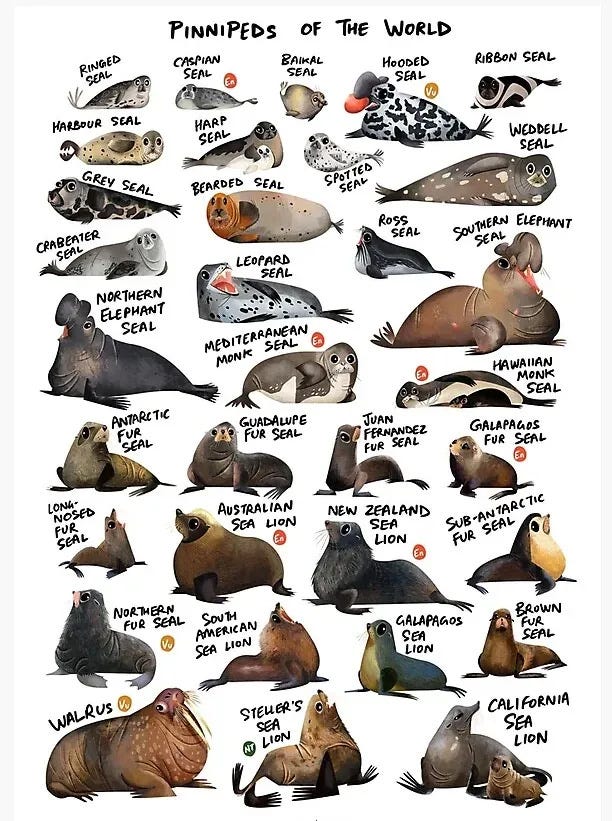
anyways, as we can see there are many types of pinnipeds. each has been categorized, taxonomized, indexed. if the word pinniped was personified and was looking at the word founder, it would send this kind of vibe.
‘intelligence is organized experience; but intelligence itself must be organized.’
'what we need, as sarah perry writes in her essay series for carcinisation, is “more stamp collecting, less darwin”—more local, particular, detailed accounts and descriptions, theories specific and developed enough to really be stress-tested by prediction. we cannot get ahead of ourselves in the rigorizing pipeline, which is also a pipeline from the local, descriptive, and specific to the global, the general, the abstract.' — suspended reason on knowledge logistics
the point i’m trying to make here which should be obvious is that compared to the word pinniped, the word founder is not very organized.
we know of the solo founder, we know of co-founders, we know of the typical engineer and sales or product co-founder duo. we know of chairman/advisor/investor/silent type co-founders (this is kevin ryan/jack abraham/startup studio) that get companies of the ground. we know of the late stage co-founder (elon at tesla).
but we really lack a robust ontology for the word founder. the word pinniped is 103403420x more organized than the word founder. because we lack a robust ontology we aren’t able to further taxonomize this down and start to think about this all in a rigorous way, the way say we are to think about the different characteristics and behaviors between the harbor seal and the california sea lion.
‘systems engineering is very much about finding the correct words to describe the problem (and related risks), so that they can be readily solved via engineering solutions. jack ring said that a systems engineer's job is to "language the project." (ring et al. 2000)[22] — trend system engineering tool crack
fields make huge progress when they move from stories (e.g icarus) and authority (e.g 'witch doctor') to evidence/experiment (e.g physics, wind tunnels) and quantitative models (e.g design of modern aircraft). — dominic cummings
are you picking up what i’m putting down?
unfortunately, i have nor the time, interest or attention span to get robust on a founder ontology. but for this essay, i’m going to create the conceptual space by territorializing the idea of the solo co-founder.
solo co-founder; a founder who has a co-founder in letter, not spirit. a founder who has a co-founder but that co-founder was brought in to build the core initial product and whose scope is severaly relatively limited // did not scale with the company. if you’re a co-founder, and have a technical co-founder and then decide to hire a cto then you are probably a solo co-founder. maybe the way of thinking about the solo co-founder, is what percentage of criticial business decisions can use your co-founder as a thought partner for? the lower the percentage, the more you are a solo co-founder.
i’m not saying that there is anything wrong with the technical co-founder, or with being a solo co-founder. nor am i arguing that it is optimal to have your co-founder be a thought partner for a wide range of criticial business decisions. the idea is not to pass judgement, but carve out ontological space. as always, knowledge is an if-then statement and there are many if’s that make the then that is the above assertion invalid. contextuality, by default.
the idea of a solo co-founder is not robust, taxonomized and certainly needs to be pinnipedified but the idea holds in spirit. and once, we accept this, we see solo co-founders everywhere. what percentage of startups are run by solo co-founders? i have no idea. but i do know that because they have not been named, they have not been tamed and the problem set that surrounds this concept is ill-defined. the warf hypothesis tells us that language shapes thought and influences perception. eskimos know 13 different types of snow, some language have multiple words for different shades of blue. when we robust ontological equipment we are able to see, which means necessarily we are better positioned to manipulate.
referencing the same quote twice in an essay, maybe i should just get it tatted
‘systems engineering is very much about finding the correct words to describe the problem (and related risks), so that they can be readily solved via engineering solutions. jack ring said that a systems engineer's job is to "language the project." (ring et al. 2000)[22] — trend system engineering tool crack
what are the problems that a solo co-founder faces?
if the assumptions hold, then sharing the emotional burden is a big one. if one founder is the guy who built the mvp // is the spiritual brand ambassador and the other founder is the one who is subject to the pressure conditions of the organization then the solo founder is emotionally at sea alone. this isn’t a novel idea, we know solo founders deal with this all the time — but it’s worth stating
general thought partner — who are they working with to think through criticial decisions. we know that initial conditions are extremely sensitive. — we know that coordination debt piles up. a penny doubled daily surpasses half a million doubled every three days in just over a month. who is able to help them think things through?
scaling challenges – difficulty scaling the organization or product without a complementary co-founder who can take on new roles or provide support during growth phases.
general burnout risk – the pressure of doing everything yourself, increasing the likelihood of burnout // diminishing the capacity for long-term productivity.
this is all (a) a projection (b) correct in spirit (c) a general reminder of the importance of choosing the initial conditions (which we define as (d) the emergence of self-locking properties via relationship contracts between entities (which in this case would be co-founders)).
how well define is our language say to talk about api’s?